

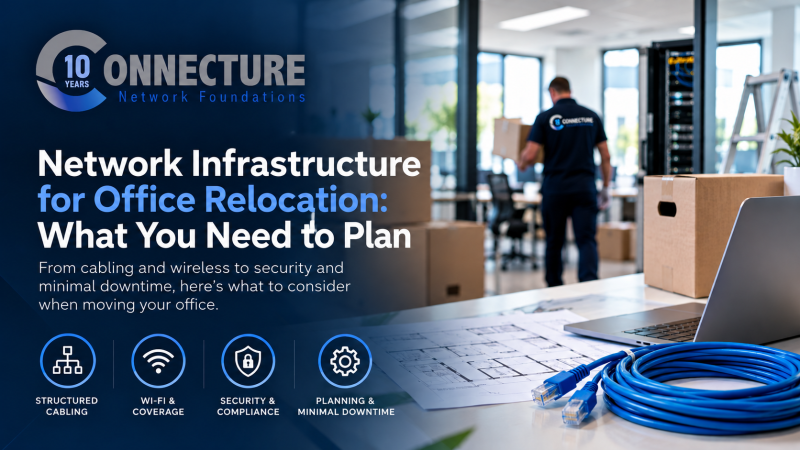
Moving offices? Make sure your network infrastructure is ready before you move in.
Relocating your business to new premises is an exciting opportunity. Whether you're expanding into a larger office, consolidating multiple locations or moving to a more modern workspace, there's plenty to organise.
However, while furniture, equipment and moving arrangements often take priority, one essential consideration can easily be overlooked: your network infrastructure.
A reliable, secure and well-planned network is fundamental to almost every aspect of modern business operations. From everyday internet access and cloud applications to video conferencing, wireless connectivity and cybersecurity, your infrastructure needs to be ready from day one.
At Connecture, we help businesses plan, install and optimise the network infrastructure that keeps their operations connected.
Here are some important considerations when planning your next office relocation.
1. Assess Your New Office Before Moving In
Every building is different, and what worked in your previous premises may not be suitable for your new workspace.
Before committing to your network installation, it's important to assess the building's existing infrastructure.
Consider:
Does the building have sufficient network cabling?
Are there enough data points for your proposed desk layout?
Where will your communications cabinets and network equipment be located?
Is the existing infrastructure capable of supporting your current and future requirements?
Are there any building restrictions that could affect installation?
A professional network audit or site survey can identify potential problems early, allowing you to address them before employees arrive.
2. Plan Your Structured Cabling
Structured cabling forms the backbone of a reliable office network.
Whether you're moving into a newly constructed building or refurbishing existing premises, your cabling infrastructure should support both your immediate requirements and future growth.
Consider the number and location of workstations, meeting rooms, printers, wireless access points and other connected devices.
Installing the right copper and fibre cabling from the outset can help prevent unnecessary disruption and additional costs further down the line.
A well-designed cabling system isn't just about connecting today's equipment. It's about creating an infrastructure that can adapt as your business grows.
3. Don't Overlook Wireless Coverage
Modern workplaces depend heavily on wireless connectivity.
Employees increasingly move between desks, meeting rooms and shared spaces, using laptops, tablets and mobile devices throughout the working day.
However, achieving reliable wireless coverage involves more than simply installing a few access points.
Building materials, office layouts, neighbouring networks and the number of connected devices can all influence wireless performance.
A professional wireless survey can help determine the most effective positioning and configuration of access points, delivering consistent coverage across your new premises.
4. Build Security Into Your Network From the Start
An office relocation provides an ideal opportunity to review your network security.
Rather than simply transferring existing equipment and configurations, consider whether your current security measures remain suitable for your organisation.
Areas worth reviewing include:
Firewall and network security configurations
Secure wireless access for employees and visitors
Network segmentation and access controls
Device and endpoint protection
Vulnerability management and ongoing monitoring
Planning security alongside your infrastructure can help reduce vulnerabilities and provide a stronger foundation for your business.
5. Plan Connectivity and Minimise Downtime
One of the biggest concerns during an office relocation is business interruption.
Employees need access to emails, cloud platforms, communication systems and business-critical applications as quickly as possible.
Internet connectivity and service availability should therefore be considered well in advance of the moving date.
Lead times for new connectivity services can vary significantly, particularly where additional infrastructure or installation work is required.
Where practical, arranging installation, testing and commissioning before the move can help reduce disruption.
A phased migration may also be appropriate for businesses that need to maintain operations throughout the relocation.
6. Think Beyond Moving Day
Your new office network should be designed for the business you expect to become, not simply the business you are today.
Additional employees, new technologies, increased bandwidth requirements and changing working practices can all place greater demands on your infrastructure.
Building flexibility into your network from the beginning can make future expansion easier and more cost-effective.
Make Network Planning Part of Your Office Relocation Strategy
A successful office move isn't simply about transferring people and equipment from one building to another.
It's about creating a workspace that allows your business to operate efficiently, securely and without unnecessary disruption.
By planning your network infrastructure early, you can avoid costly surprises, reduce downtime and ensure your new premises are ready to support your business from day one.
Planning an Office Move? Talk to Connecture.
At Connecture, we provide professional network infrastructure services for businesses across the UK, including structured copper and fibre cabling, wireless surveys and deployment, network audits and associated infrastructure services.
Whether you're relocating to a new office, expanding your existing premises or planning a complete network upgrade, our experienced team can help you create the right foundations.
Get your network ready before moving day.

